
Transplantation - Behind the Paper with Robson Gilmour and Mekhola Hoff - January 5, 2026

INTRODUCTION
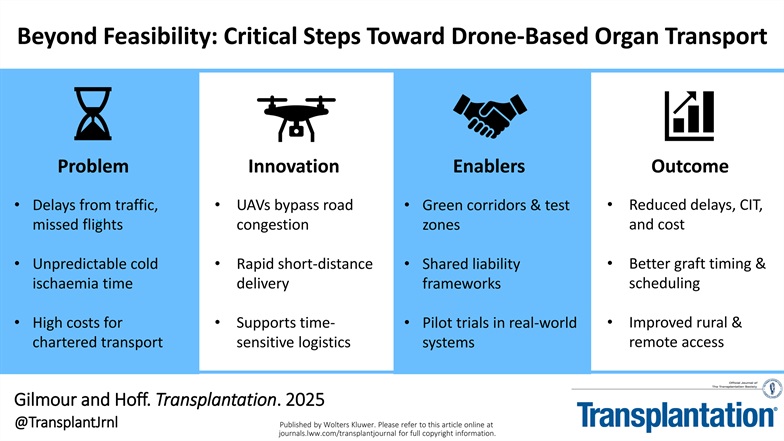
Drones, or uncrewed aerial vehicles (UAVs), are becoming increasingly visible in healthcare logistics. In several countries, they already deliver blood, vaccines, and laboratory samples to remote areas, helping overcome geographic and infrastructure challenges. Trials in high-income countries also show that UAVs can deliver medicines faster and with lower emissions than conventional transport methods. Globally, transplant systems face common logistical challenges, particularly around time-critical organ delivery.
Transplantation presents a powerful case for innovation. Organ transplant success depends not only on matching but on timing. Once retrieved, an organ must be transplanted within a narrow window, known as the cold ischemia time. Delays reduce viability and worsen outcomes.Although ambulances, aircraft, and couriers generally work well, they are costly, complex to coordinate, and vulnerable to delays. A single miscommunication can result in an organ no longer usable.
Drones offer a potential way to reduce these delays by replacing one leg of a journey or streamlining local transfers. So far, a few successful test flights have been reported, but routine adoption requires more than just technical success. Regulatory clarity, cost-effectiveness, clinical evidence, and integration into existing systems must follow.
Contact
Address
The Transplantation Society
International Headquarters
740 Notre-Dame Ouest
Suite 1245
Montréal, QC, H3C 3X6
Canada
Используйте Вавада казино для игры с бонусом — активируйте промокод и начните выигрывать уже сегодня!