

Special ISVCA Feature


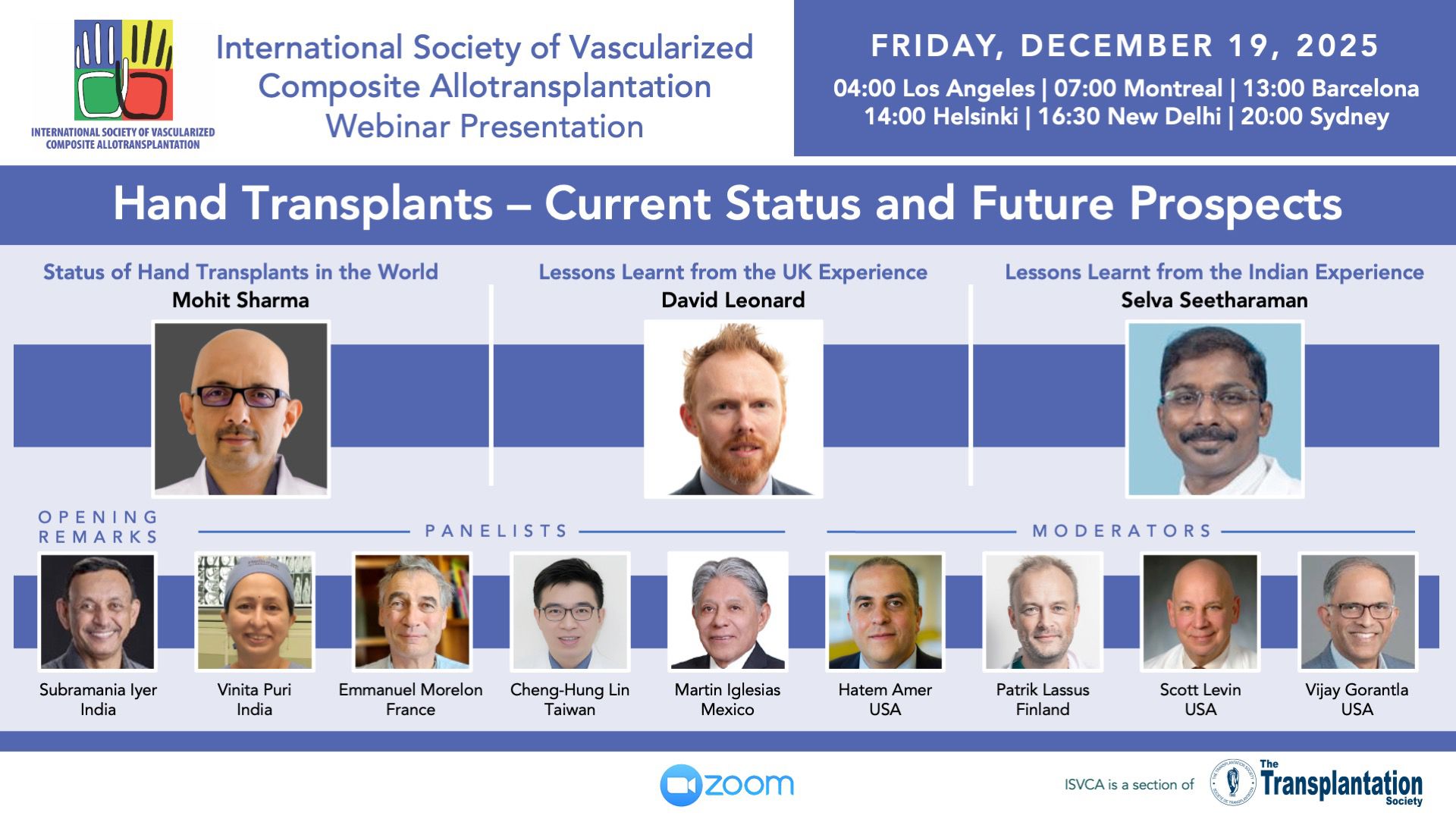
The first initial hand transplantation in 1964 was performed in Ecuador by Dr. Roberto. This was unsuccessful due to a variety of factors, including inadequate immunosuppression. 34 years later, the first successful hand transplantation was performed in Lyons France by Dr. Max DuBernard. The patient was noncompliant with immunosuppression ultimately resulting in re-amputation of the unilateral transplant. Currently the world‘s longest surviving Transplant is from Louisville, Kentucky, which was performed by a team led by the late Dr. Warren Breidenbach. The first bilateral double hand transplant was performed in France by Dr. Max DuBernard and his team. The first pediatric bilateral upper limb transplant was performed in Philadelphia in the United States by Dr. L. Scott Levin. Other firsts include a double hand transplant for scleroderma in a patient that was operated on by Dr. Simon Kay’s team in the United Kingdom and Leeds in 2022.
As of 2025, 96 patients had undergone hand transplantation. 37 double upper extremity transplants have been done in India followed by the United States, which has performed 19 patients. Other centers around the world include Australia, Austria, Canada, Finland, Italy, Korea, Mexico, Poland, Sweden, Taiwan, Turkiey, and Vietnam. Considerations regarding renal function and patient selection are critical. Some countries regard Hand transplantation as standard of care but other countries such as the United States render this surgery experimental and is not considered standard of care in select patients despite the report from the National Academy of Science Engineering and Medicine. In 2025 a recent consensus conference convened by the National Academy, that in select patients, and properly prepared teams with aggregate expertise, Hand transplantation can be considered as a reasonable treatment and alternative to prosthetic use. The health finances of Hand transplantation were discussed. Depending on the country’s health system, government or private funding may be available.
Maintaining limb viability either with perfusion solutions or ex vivo perfusion are modalities that are evolving in hand transplantation. Postop therapy to optimize nerve recovery includes electrical stimulation. In the United Kingdom, Hand transplantation is considered standard of care with funding coming from the United Kingdom National Health Service.
The majority of the UK patients have been transplanted as a result of sepsis and limb loss. Like most centers around the world Hand transplantation is presented as an option to patients only if they fail or are unwilling to wear conventional prosthetics or myoelectric prosthetics. A lot has been learned in the field related to rejection whether it’s humoral or cellular based rejection.
Different countries around the world have issues with the lack of organ donation. This has affected programs in Leeds England. The role of forming and maintaining and rehearsing a large team to effectively carry out hand transplantation was emphasized by Dr. Leonard. This is true around the world.
Selva Seetharaman described the formation of the Indian Society of Reconstructive Transplantation, which is a subsidiary of the Indian Society of Organ Transplant. Similar to the United States and other countries, small societies dedicated to reconstructive, transplantation, or being created to complement the larger solid organ transplant societies.
India accounts for 1/3 of the world experience which is 87 of the 264 transplants performed worldwide. The cost in India is US$25,000-US$28,000. In the United States, the cost is 20 times that amount. Due to the size of India, different teams help each other in transplant, but the issues related to donation and transporting the limb are significant. There are global differences in donor availability, funding for transplant patients, and healthcare policies.
With that being said, the restoration of function and dignity in patients who have successfully undergone upper-extremity vascularized composite allotransplantation (VCA) is highly impactful. Despite headwinds and various challenges, this field will continue to evolve and offer hope to patients, particularly through improvements in quality of life.
Contact
Address
The Transplantation Society
International Headquarters
740 Notre-Dame Ouest
Suite 1245
Montréal, QC, H3C 3X6
Canada
Используйте Вавада казино для игры с бонусом — активируйте промокод и начните выигрывать уже сегодня!